

10 Traditional Games from India: Get Ready for some Indoor Board and Strategy Games!
10 Traditional Indian Board Games to Play with Your Kids
Looking for traditional Indian board games to play with your family? Here are 10 classics, from strategy games to games of chance, that are perfect for a fun evening indoors.
I'm an ardent fan of Pallankuzhi, the traditional South Indian board game. I learned it when I was eight, and during the holidays I would play for hours at a stretch.
Recently, a visit to a shop brought those memories rushing back. It made me realize how many of these games have quietly faded away. With this post, I hope to revive a few of them, and the memories that come with them.
1. Ashtapada

The Ashtapada board is an eight-by-eight grid, like a chessboard, except all the squares are the same color. Some squares are marked as "castles," where a piece is safe from capture. Players race their pieces around the board and into the center. A larger ten-by-ten version is called Dasapada.
2. Chaturanga
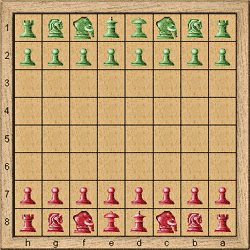
Chaturanga is an ancient Indian strategy game, widely believed to be the common ancestor of chess, shogi, makruk, xiangqi, and janggi. Its exact rules have been lost to history. The name comes from a battle formation in the Mahabharata and refers to the four divisions of an ancient army: elephants, chariots, cavalry, and infantry.
Read and play: Meet the armies behind the game in Mahabharata Stories, a collection for ages 9+ that includes tales like the palace of lac, Draupadi's swayamvara, and the passing of Bhishma.
3. Moksha Patam (Snakes and Ladders)
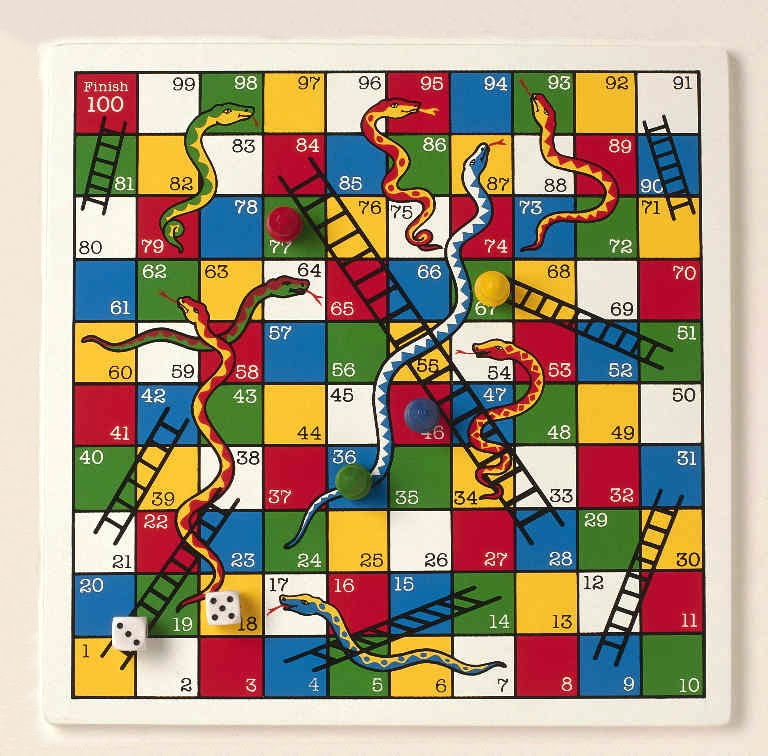
Also called Parama Padam or Gyan Chauper, Moksha Patam is the ancient Indian dice game the world now knows as Snakes and Ladders. It was meant to teach values as well as entertain. Ladders stood for virtues and snakes for vices, and players climbed from lower levels of consciousness toward spiritual liberation, or moksha.
Read and play: Explore the ideas behind the game's virtues and vices in Tales From The Vedas And Upanishads, 25 stories retold by Daaji for ages 6 to 8, including the boy who met the Lord of Death. After playing, talk about which "ladders" and "snakes" show up in the stories.
4. Pallankuzhi
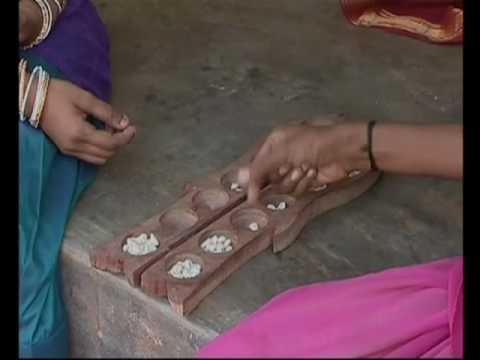
Pallankuzhi is an ancient Tamil mancala game for two players, especially popular in Tamil Nadu. It spread to Karnataka, Andhra Pradesh, Kerala, Sri Lanka, and Malaysia, where it goes by names like Ali Guli Mane (Kannada), Vamana Guntalu (Telugu), and Kuzhipara (Malayalam).
The board has two rows of seven pits (kuzhi in Tamil), 14 in all. Players use 146 counters, usually seeds or cowrie shells, to fill the pits and play.
Read and play: In Tara and the Friendship Theorem, Tara and her best friend play Pallankuzhi in a story about moving and making new friends.
5. Aadu Puli Attam (Goats and Tigers)
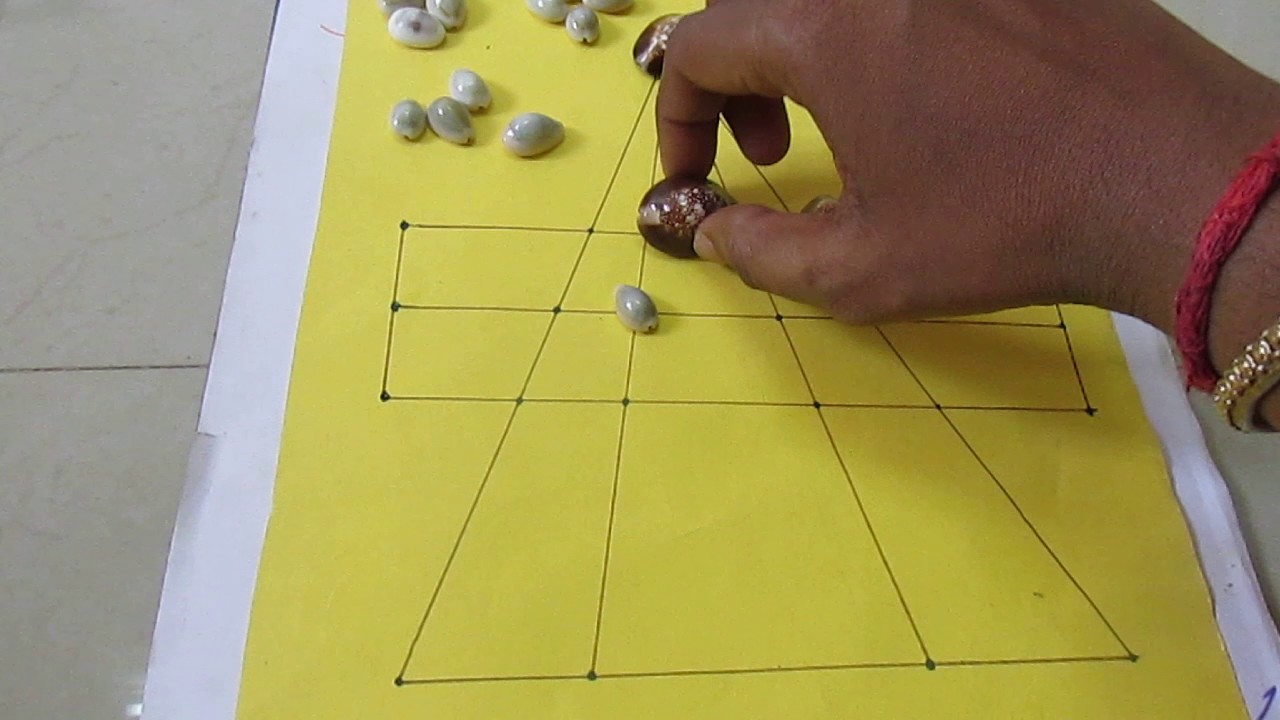
Known as Aadu Puli Attam in Tamil, Puli Meka in Telugu, Aadu Huli in Kannada, and Pulijudam, this is a strategy hunt game for two players or two teams from South India.
The sides are uneven: one player has three tigers, the other up to 15 goats. The tigers hunt the goats, while the goats try to surround the tigers so they can't move.
6. Pachisi

Often called the "national game of India," Pachisi is played on a board shaped like a symmetrical cross. Players move their pieces by throwing six or seven cowrie shells; the number that land with the opening facing up tells you how many spaces to move.
The name comes from the Hindi word pachis, meaning twenty-five, the highest score you can throw. Two to four players split into two teams, one with yellow and black pieces and the other with red and green. The first team to bring all its pieces home wins.
7. Pandi Attam (Hopscotch)
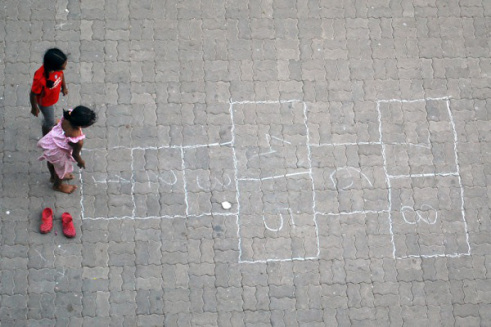
Nondi or Pandi Attam is a hopping game still played in many villages across Tamil Nadu. It's called Tokkudu Billa or Tangidi Billa in Andhra Pradesh and Kunte Bille in Karnataka. Players toss a small object into numbered boxes drawn on the ground, then hop through the boxes to pick it up. It's a great one to take outside!
Read and play: Bounce Hop Raaga Pop connects hopscotch with Indian classical music and mathematical patterns. It includes an activity for children to try, plus a QR code for audio patterns in the author's voice.
8. Dayakattai
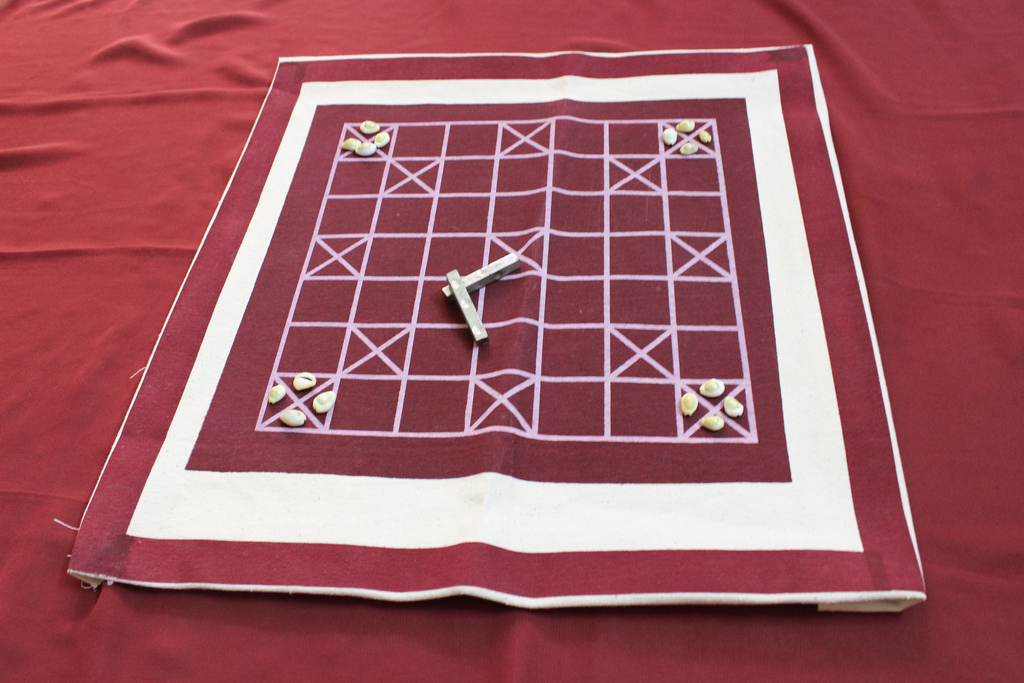
Dayakattai is a dice game for two or four players from Tamil Nadu, similar to Pachisi, with many regional variations. The name comes from the Tamil word thayam. It uses a pair of long, rectangular dice, also called the dayakattai, which go by names like Daayam and Daala.
9. Chowka Bara
One of India's oldest board games, Chowka Bara is still played in parts of the country. It's known as Chowka Bara in Mysuru and Chakaara or Chakka in north Karnataka. Up to four players race their pawns from the start to the safety of home, much like Ludo, moving by throwing cowrie shells (kavade in Kannada). It's a game of chance, but it rewards good strategy too.
10. Saalu Mane Ata

Saalu Mane Ata, also called Char-Par in Kannada and Navakankari in other parts of India, is the Indian version of Nine Men's Morris. Each of the two players gets nine pieces and tries to line up three in a row, which lets them remove one of the opponent's pieces. It takes real strategic thinking!
Let's try to introduce at least a few of these games to our kids, and keep them alive for the next generation.
What was your favorite childhood board game? Share it in the comments below!